
TL:DR
- Competing directly with OnlyFans is extremely difficult due to strong network effects, creator trust, and deep audience lock-in that cannot be replicated with a simple clone.
- Most “OnlyFans clones” fail because they compete on features instead of identity, positioning, or solving a specific creator problem that actually drives demand.
- Customer acquisition is expensive and inefficient in the adult space, with restricted ads and a cold-start problem that prevents new platforms from reaching critical mass.
- Creators rarely switch platforms for lower fees alone, since income depends more on audience size and retention than commission percentages.
- The real opportunity lies in niche markets and creator tools, especially SaaS products like compliance, analytics, agency management, and monetization support rather than building another generic platform.
Every quarter, a new wave of founders enters the adult creator economy convinced they can build the next OnlyFans clone. The logic seems simple because OnlyFans generated $7.22 billion in gross revenue in 2024, proving just how massive the opportunity is.
But revenue numbers tell only half the story.
What many founders underestimate is the deep competitive moat behind that success. Creator trust, payment stability, brand loyalty, and years of market dominance cannot be replicated with a clone script or white label platform.
That is exactly why competing with OnlyFans directly is the wrong strategy for clone founders. The smarter opportunity is not building another copy. It is finding the gaps OnlyFans has left open and building where it cannot easily follow.
1. OnlyFans Already Owns the Network Effect
OnlyFans has 4.63 millions of paying fans and over 377.5 million registered creators as of 2026. That number isn’t just a vanity metric. It represents a self-reinforcing loop that took years to build. Creators go where fans already are and fans follow the creators they love. The platform just sits in the middle and collects 20%.
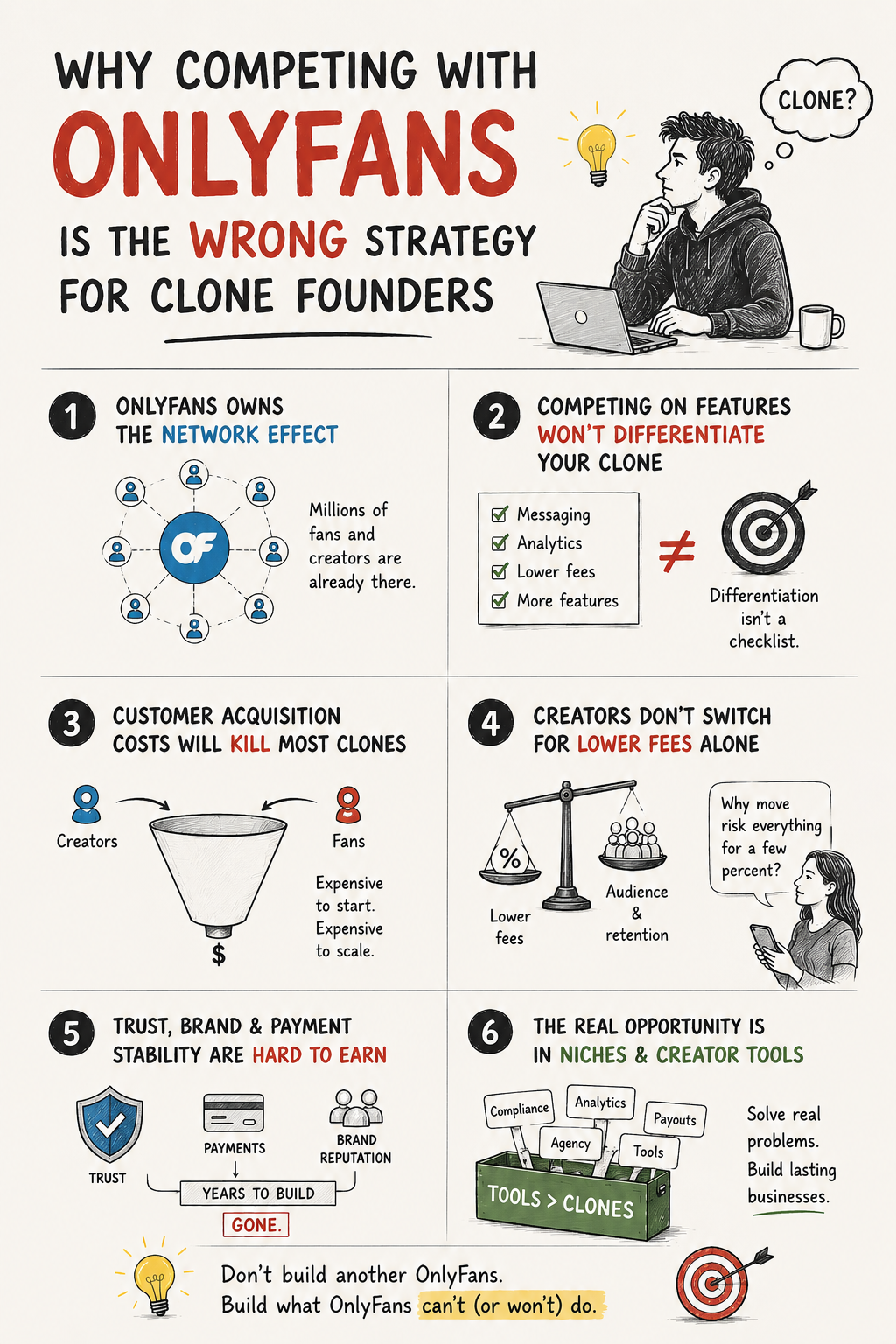
This is what economists call a network effect, and it’s the single most defensible moat in the platform business. The more people use it, the more valuable it becomes. And the more valuable it becomes, the harder it is for anyone new to break in.
When you launch your OnlyFans clone with zero creators and fans, you’re not competing with a product, you’re competing with a network. Those are two completely different problems, and the second one is much, much harder to solve with a development budget and a launch campaign.
Fansly figured this out during the OnlyFans’ 2021 policy reversal and broader X NSFW uncertainty. They didn’t just build features, they aggressively courted creators already frustrated with OnlyFans’ payment policies, and they offered real migration support. Even then, with ideal timing and genuine platform problems to exploit, Fansly still sits at a fraction of OnlyFans’ size years later.
2. Competing on Features Alone Won’t Differentiate Your OnlyFans Clone
Ask ten OnlyFans clone founders what makes their platform different and nine of them will say something like: “We have better messaging, better analytics, and lower fees.”
That’s not a differentiation strategy, that’s a feature checklist.
The adult creator platform space is full of technically competent products that nobody uses. Fanvue, LoyalFans, & FanCentro are all credible platforms built by capable teams with competitive feature sets, yet they remain largely unknown outside the industry. Not because the software is bad, it is that features alone rarely create demand.
What actually creates demand is identity. Why does someone use Substack instead of Medium? Why do people pay for Patreon instead of just following someone on YouTube? Because those platforms built a story around the type of creator they serve and the type of fan experience they offer.
If your pitch is “it’s like OnlyFans but with better analytics,” you’ve already lost. You’ve defined yourself entirely in relation to a competitor. You’re asking creators to take a risk on an unproven platform for marginal product improvements they may not even notice. That’s not a compelling enough reason for anyone to make a move.
📌Pro Tip: Identity is what makes creators stay, features are just what gets them curious. If your platform stands for nothing specific, it’ll attract no one specific. Learn how to build with purpose in making money from an OnlyFans clone.
3. Customer Acquisition Costs Will Kill Most OnlyFans Clones
This is the math that never shows up in anyone’s pitch deck.
To run a content platform, you need two types of customers, creators & fans and you need them at the same time. You can’t have one without the other, and you can’t charge either of them until you have both. This is called the cold start problem, and it’s expensive.
Let’s say you acquire a creator for $200 in marketing spend. That creator publishes content, but they only earn if fans subscribe. So now you need to acquire fans too. In the adult space, paid acquisition through mainstream channels like Google and Meta is largely restricted.
You’re stuck with influencer deals, Reddit campaigns, X promotion, and affiliate networks and none of it is cheap. That’s why having the right marketing strategy for your OnlyFans clone website makes all the difference before you spend a single dollar.
Meanwhile, that creator you spent $200 acquiring is watching their subscriber count sit at zero, and they’re logging back into OnlyFans within 90 days. You’ve spent the money but you got nothing back.
Adult startups face a particularly brutal version of this problem because ad platforms actively limit their options. A regular SaaS company can run Google search ads, LinkedIn campaigns, and retargeting funnels at scale but an adult platform cannot.
Your CAC is structurally higher and your conversion windows are tighter. That’s a dangerous combination for a business that needs to reach critical mass before revenue starts flowing.
4. Creators Rarely Leave OnlyFans for “Another OnlyFans Clone”
The “lower commission” argument sounds great in theory. OnlyFans take 20% and if you offer 10%, creators make more money. Simple, right?
Wrong! Income on a platform isn’t just about percentage, it’s about volume. A creator making $10,000 a month on OnlyFans at 80% take-home nets $8,000. If they move to your platform at 90% take-home but only generate $2,000 in revenue because the fan base isn’t there, they’re making $1,800. They just lost $6,200 to save on commission.
Creators understand this math intuitively, even if they don’t spell it out. Switching platforms means rebuilding an audience, re-promoting subscription links, updating bios across social media, and asking fans to re-subscribe somewhere new. Every step in that process creates friction and churn.
Some fans will not make the move, while others may unsubscribe during the process. The result is often short-term revenue loss, greater uncertainty, and added pressure for creators.
When creators do leave OnlyFans, they typically do not leave for a generic alternative. They move toward platforms built to solve a specific problem, whether that is stronger privacy controls, better support for couples or niche creators, or more advanced tools for agencies and teams.
A lower commission rate alone is rarely enough to justify that transition. To truly compete, a platform must offer something OnlyFans structurally cannot and that is where the real opportunity lies.
5. The Bigger Opportunity Is in Adult Niches, Not Generic OnlyFans Clones
The adult creator economy is not a single, unified market, it is a collection of highly distinct sub-markets with very different needs.
There are AI-driven adult content platforms dealing with unique legal, ethical, and moderation challenges. There are fetish-driven communities where discovery, trust, and context matter far more than broad reach. There are couple-based creators whose audience behavior and content dynamics differ significantly from solo performers. There are also creator agencies managing large portfolios of accounts, requiring operational tools that most platforms simply do not offer.
Each of these segments represents a real, underserved market. And critically, each one has specific problems that a generic “OnlyFans clone” is not designed to solve.
This pattern is not unique to adult platforms. Broader creator systems show the same trend, successful platforms tend to win by focusing deeply on a defined user type rather than attempting to serve everyone. Even large incumbents continue to struggle with identity trade-offs across different creator categories.
In the adult space, this becomes even more pronounced. A platform built specifically for BDSM or kink communities with tailored discovery, tagging systems, and community-oriented features would not be competing directly with OnlyFans in the traditional sense.
OnlyFans functions primarily as a monetization layer, not a discovery or community engine. That gap leaves room for niche platforms that organize audiences around intent rather than just subscriptions.
Owning 80% of a niche is worth more than owning 0.1% of the mainstream market, especially when the niche has money to spend and nowhere else to go.
6. The Smartest Founders Build What OnlyFans Doesn’t
There’s a version of this opportunity that most people overlook completely, and it’s often more profitable than any platform play.
OnlyFans is not going to build a CRM for creator agencies. It’s not going to build a tax compliance tool for adult content creators who need to manage 1099s across multiple platforms. It’s not going to build a content scheduling and recycling tool, or an AI-assisted pricing optimizer, or a fan retention analytics suite. These are B2B products, and platforms don’t build tools for the people who use them to earn money.
But someone should and whoever does, gets paid by every creator and agency on every platform simultaneously.
This is the “adult SaaS” layer, tools that operate across systems rather than within a single platform.
- Agency management software that helps talent managers handle dozens of accounts without losing their minds.
- Payment processing and financial tools built for adult creators who get dropped by mainstream processors.
- Content protection and DMCA takedown services.
- Age verification and compliance software for OnlyFans clones that need to meet 2257 requirements.
None of this requires building a platform, solving cold start problems, or competing with OnlyFans network effects. The focus is simply on building something useful for people who are already earning money and need better tools to run their work.
This is where the B2B advantage becomes clear. The customer is not a casual user but a business. Businesses pay for tools that save time or increase income and that usually means higher willingness to pay, lower churn, and more stable revenue over time.
For context, mainstream creator tools already follow this pattern. Companies like Beehiiv, ConvertKit, and Kajabi grew by serving creators instead of competing for attention. The adult creator space still does not have a mature tools layer like this. That gap is the opportunity.
Final Thoughts
The adult creator economy is full of opportunity, but not where most founders first look. Creating a website like OnlyFans means stepping into a market already defined by strong network effects, limited acquisition channels, and creators who rarely move for small improvements. The real opportunity sits elsewhere, in niche communities, agencies, and creators who need better monetization, management, and growth tools. Founders who move away from imitation and focus on meaningful problems will find far more durable success. xFans by Adent.io stands out as one of the best OnlyFans clone software solutions, designed to help creators and agencies scale smarter, earn more, and grow beyond platform dependency.
FAQs on What Founders Get Wrong About OnlyFans Clones
1. Why do better features alone fail to differentiate an OnlyFans clone?
Platforms like Fanvue & LoyalFans have competitive features and still remain niche. Features attract attention but don’t create demand. What drives adoption is a clear platform identity that speaks to a specific creator type, not a longer feature list.
2. Why don’t creators leave OnlyFans even when they’re unhappy with it?
Switching means rebuilding an audience, updating all promotion links, and asking fans to re-subscribe, creating friction and churn at every step. Creators don’t leave for generic alternatives; they move only when a platform solves a specific structural problem OnlyFans cannot.
3. How does defining your platform “like OnlyFans but better” hurt you from day one?
It anchors your identity to a competitor, immediately framing you as a lesser alternative. It gives creators no compelling reason to take a risk on you. Positioning must stand alone, not lean on OnlyFans as a reference point.
4. Can AI-driven adult content platforms succeed where traditional OnlyFans clones fail?
Yes! AI content operates in a structurally different space with unique legal, moderation, and monetization dynamics that OnlyFans is slow to address. Founders who solve those problems first carve out defensible ground.