

TL;DR
- Ofcom has started issuing fines, while the Supreme Court of the US cleared the way for stricter age-verification laws. In Germany, regulators can now pressure payment providers to cut off non-compliant adult platforms.
- Creator verification and subscriber age assurance solve different legal problems.
Treating them as one workflow creates audit gaps and often fails both requirements. - The strongest verification stacks use layers like facial age estimation first, government ID as fallback, then token-based re-verification. Relying on a single method usually hurts conversions and creates avoidable compliance risk.
- Adult payment providers like CCBill, Segpay, & Paxum can suspend your merchant account before regulators act. Your verification stack should be approved by your processor before launch.
- Centralized ID storage creates long-term privacy and security risk for adult platforms.
Zero-knowledge proofs and double-blind tokens, backed by eIDAS 2.0, point to where the industry is heading.
For years, age verification on adult platforms was little more than a checkbox, easy to bypass, ignore, and largely accepted as “good enough.” That standard no longer exists.
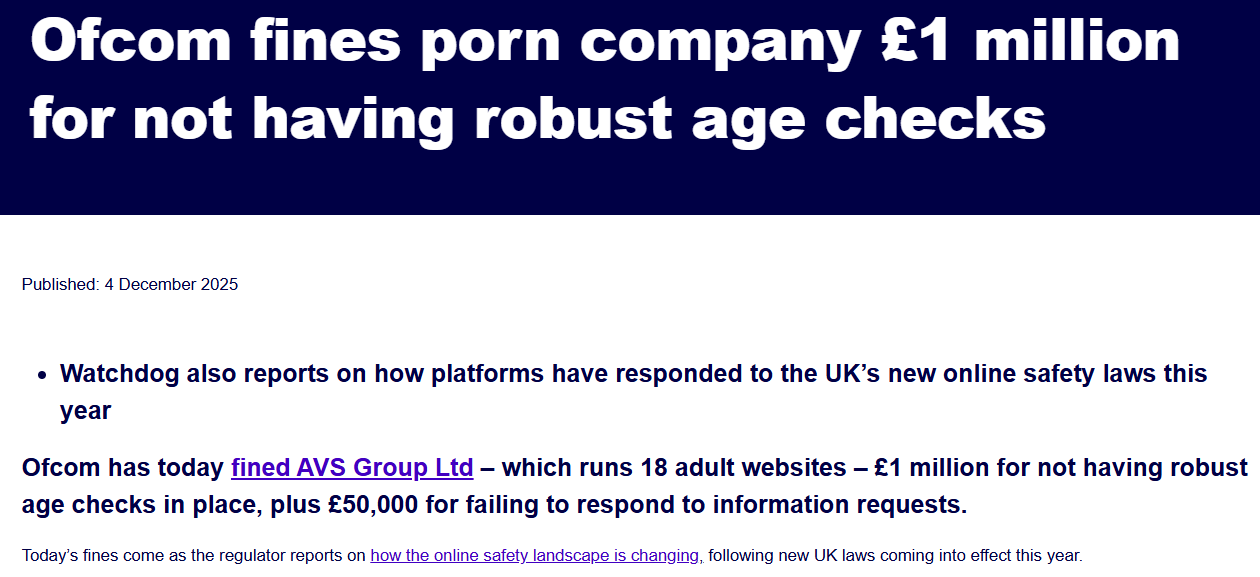
Regulators have moved from policy debates to active enforcement. Since Ofcom began enforcing the Online Safety Act in July 2025, it has opened more than 90 investigations and issued a £1 million fine.
In the US, the Supreme Court of the United States upheld Texas HB 1181 in mid-2025, triggering a wave of similar legislation across multiple states. Australia followed in March, while the European Union is already piloting a digital identity wallet across five member states.
If you run an adult fan platform, a subscription site, the challenge is not simply adding verification. It is implementing age verification for OnlyFans-like platforms in a way that satisfies regulators, protects user privacy, and preserves conversions. This guide explains what platform owners need to understand and what they need to do next.
How Age Verification for Adult Platforms Became a 2026 Business Risk?
Three things happened that pulled the bottom out from under the old age verification model for adult sites.
First, regulators started enforcing. Ofcom moved beyond warnings and began issuing penalties of a £1 million fine in December 2025, followed by an £800,000 penalty against Kick just weeks later. On the first day of UK enforcement alone, millions of age checks were processed. The message was clear, this was no longer theoretical.
Second, the legal barrier in the US fell. When the Supreme Court of the United States upheld Texas HB 1181 in 2025, it accelerated a wave of state-level legislation that continues into 2026.
Third, enforcement moved beyond websites. Germany changed the rules in December 2025 so authorities can require banks and payment providers to stop processing for non-compliant adult platforms. California’s AB 1043 pushes age verification down to the device level. Utah’s App Store Accountability Act puts the obligation on Apple and Google directly. The pressure is moving up the stack.
For adult platform founders, the risk is now operational with fines, payment disruption, geo-blocking, and lost revenue. Ignoring age verification is no longer a viable strategy.
OnlyFans Age Verification and the Subscription Creator Problem
Age verification on a tube site is one problem. Age verification on an OnlyFans-like platform is three.
Subscription creator platforms face pressure from every direction. Every creator must be verified at onboarding. Every subscriber accessing adult content increasingly requires age assurance. And every paid interaction like subscriptions, direct messages, PPV unlocks, custom content, and tips creates an additional compliance and payment-risk layer.
OnlyFans recognized this early and built around it. Today, creators can’t just sign up and start posting, onboarding typically requires government-issued ID, biometric verification, and additional re-checks whenever key account details change. Competitors such as Fansly and Fanvue have largely adopted the same model. The reason is simple, payment providers like CCBill, Segpay, and Paxum require these verification standards as the price of entry to operate in the industry.
Where many new founders miscalculate is assuming subscriber checks can remain optional. That may have worked in the past; it does not anymore. Under the Online Safety Act and similar laws emerging across US states, payment alone is not proof of age.
The practical takeaway here is that age verification for OnlyFans-like platforms now requires two distinct systems: full identity verification for creators, and privacy-first age assurance for viewers. If you build one flow and try to stretch it across both, you will fail audits on both ends.
Age Verification Methods for Adult Sites That Actually Hold Up
Nobody is locking you into a single method. Regulators want high assurance and stronger privacy protections. With modern age verification software for adult sites, the choice of how to get there is yours, but the options have become far more complex.
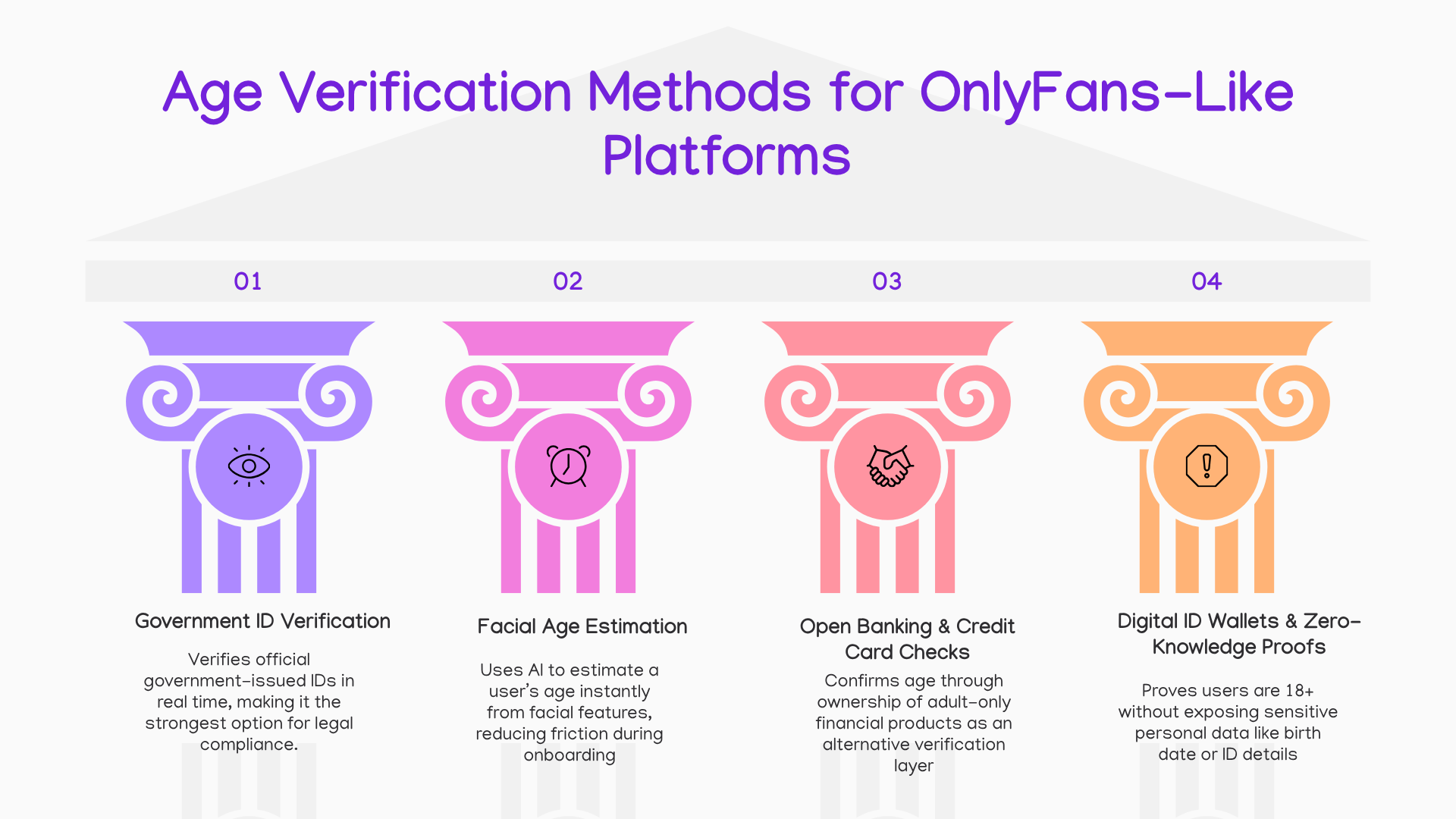
1. Government ID Verification
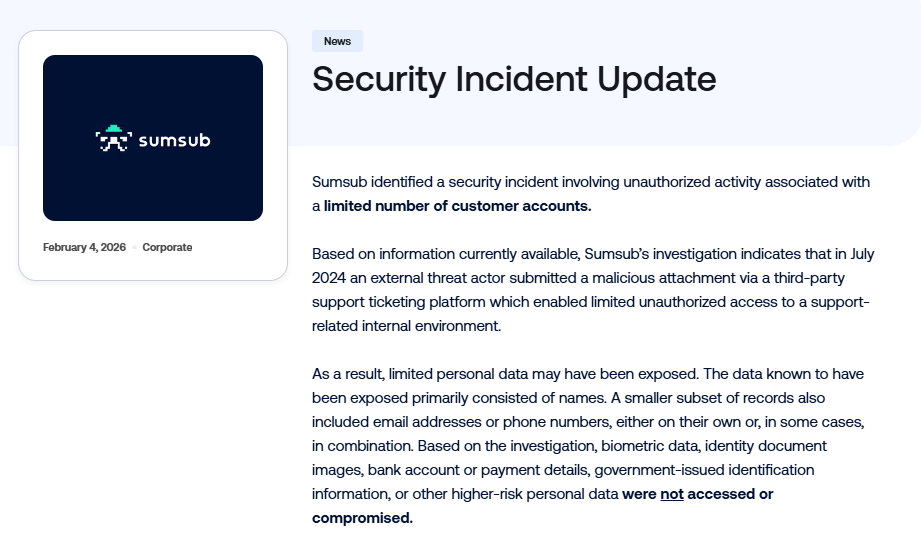
It is the strongest legal defense an adult platform can build. Every major regulator accepts it. Users upload a passport or driver’s license, a third-party vendor validates it in real time. The catch is what happens after, if your vendor stores those IDs centrally, you are sitting on a breach waiting to happen. Sumsub disclosed an 18-month-old breach in February 2026. That alone should make every founder reread their vendor contracts.
2. Facial Age Estimation
Facial age estimation is fast and Ofcom-approved for adult site verification. It reads facial features and estimates an age range. Works well at the obvious ends, struggles around the boundary. A 35-year-old looks 35. An 18-year-old who looks 16 gets bounced into a fallback flow, which is fine if you have one and a conversion-killer if you don’t.
3. Open Banking and Credit Card
Open banking and credit card checks work in the UK & EU as a financial-age proxy. You confirm the user has a financial product that minors cannot legally hold. Less useful in the US where debit cards reach minors, but reasonable as one option in a layered adult platform setup.
4. Digital ID wallets and Zero-Knowledge Proofs
Digital ID wallets and zero-knowledge proofs are where age verification for adult content is heading. The EU eIDAS 2.0 wallet, Louisiana’s LA Wallet, the EU prototype being piloted in five countries. They prove “over 18” without revealing the birth date or other personal data. That is exactly the direction privacy regulators want, and increasingly, what data protection authorities are expected to require.
The smartest adult platforms are already moving to a layered model – start with facial age estimation because it’s fast, low-friction, and inexpensive. Escalate to government ID checks only when the system flags edge cases.
Then issue a privacy-preserving verification token, so users can be re-verified later without the platform storing sensitive personal data. That is where compliant, scalable age assurance is heading.
Creator vs Subscriber Age Verification: Two Different Regulatory Problems
Platform founders confuse these two constantly, but they solve entirely different problems.
Performer age verification is about proving that everyone appearing in content was legally an adult at the time it was created. In the US, that means 18 U.S.C. § 2257 record-keeping requirements. Other jurisdictions have similar obligations. This requires government-issued ID, a records custodian, and legally mandated retention policies, typically handled during creator onboarding and, in some cases, at content upload.
Subscriber age verification is about controlling who can access the content. That is governed by laws like the Online Safety Act, emerging US state laws, and the Digital Services Act. Here, the focus is viewer access, verifying age before entry, before payment, and in some jurisdictions, through repeat checks.
Both apply to adult creator platforms. One is publisher liability and the other is access control. Treat them as one system, and gaps appear fast.
The Privacy Problem in Adult Age Verification
Every age verification system creates a new liability. There is no clean way around this for adult platforms. The honest job is making the liability smaller.
If you store IDs, you become a target. Adult sites already attract more attack interest than almost any other category. The Sumsub breach went undisclosed for 18 months. Multiply that across the dozens of vendors you might use, the partners they share data with, the cloud providers underneath them, and you start to see the shape of the problem.
If you delete IDs after verification, you have a different headache. You cannot re-verify and prove compliance under audit. You are trusting your vendor’s retention policy and their breach disclosure timeline, neither of which you control.
That is why the industry is shifting toward privacy-preserving verification models. Double-blind tokens separate the verification provider from the platform so neither holds the full picture. Zero-knowledge proofs confirm an attribute, like “this person is over 18,” without disclosing what backs it up. France’s CNIL was pushing for this years ago. The EU is now building it into eIDAS 2.0 as a default.
If your vendor still treats centralized ID storage as the only option, your vendor is selling you 2022’s product. Ask them what their roadmap is for double-blind verification. Ask what happens if a regulator subpoenas their database. The answers should be immediate, specific, and technically credible, not vague promises.
Why Payment Processors Drive Adult Platform Standards?
Founders often prepare for the wrong enforcer. Yes, Ofcom can fine you and the US state attorney general can sue you. But the player most likely to shut your adult platform down by Friday is your payment processor.
CCBill, Segpay, Epoch, Paxum, and the rest of the adult-friendly processors all operate under rules set by Visa and Mastercard. Those frameworks already require KYC, age verification, and content oversight from every adult platform they support. And when regulators put pressure on payment companies, processors rarely negotiate, they terminate. The relationship has always been asymmetric.
Germany’s December 2025 law made that leverage even stronger by explicitly allowing regulators to force banks and payment providers to stop servicing non-compliant adult platforms. It is already in force,not a proposal and other EU states are paying close attention.
The practical reading is that your age verification setup needs to satisfy your processor’s risk and trust team, not just the letter of the law in your target market. An adult platform that passes a regulatory audit but loses its merchant account is still finished. Validate your verification stack with your processor before launch, not after.
Choosing an Age Verification Provider for OnlyFans Like Platforms
Three filters cut the vendor list down fast.
I. Jurisdictional Coverage Matters More Than It Looks
Does the provider hold certifications for every market your adult platform serves? Ofcom approval is one thing, eIDAS alignment is another, state-by-state US compliance is a third, AU eSafety recognition is a fourth. Providers that cover one region and promise the rest is coming are providers you will be replacing in 18 months.
II. Privacy is the Next Filter
Ask directly, do they store IDs centrally? For how long? Do they offer zero-knowledge or double-blind verification? Have they disclosed any breaches in the last 24 months? If the answer to the last one is yes, ask how they handled it. Their answer will tell you more than any sales deck.
III. Fallback Flow and Conversion Data
They are where age verification vendors quietly fail their adult platform customers. A single-method provider will kill your funnel. Demand published conversion rates by method, the breakdown by region, the ability to route users by risk score and device signal. If they cannot show you their numbers, assume the numbers are bad.
Pricing should be per-verification, not per-API-call. Ongoing re-verification, which Ohio requires and which other states are quietly adopting, should be priced separately and disclosed up front. Get it in writing before you sign anything.
What Founders of OnlyFans-Like Platforms Need to Build In
OnlyFans-like platforms that come through the next 18 months will share three things. They verify on entry, not after the fact. They layer age verification methods so a failure routes into a stronger check rather than a user drop-off. They treat privacy as the default, not a feature they bolt on later. The adult platforms that delay these upgrades will spend 2026 explaining outages, suspensions, and compliance gaps. The platforms that build for this now will spend 2026 doing what matters growing.
FAQs on Age Verification for OnlyFans-Like Platforms
1. What should I ask an age verification vendor before signing a contract?
Ask whether IDs are stored centrally, what their breach disclosure history is, whether they offer zero-knowledge or double-blind verification, and how pricing scales with re-verification requirements.
2. Can my payment processor cut me off even if I pass a regulatory audit?
Yes! CCBill, Segpay, & Paxum enforce their own standards independently. Losing your merchant account happens faster than any regulatory action and is far harder to reverse.
3. How do I verify creator ages during onboarding without killing the signup conversion rate?
Use automated government ID verification with real-time validation. Keep the flow mobile-friendly, set clear expectations upfront, and route edge cases to a support queue rather than rejecting them outright.