
TL;DR
- OnlyFans creators are launching paid fan sites to reduce platform fees, account restrictions, payout issues, and limited control.
- An OnlyFans migration involves audience transfer, content, payments, compliance, testing, and marketing.
- Paid fan sites can monetize through subscriptions, PPV, tips, custom content, livestreams, VIP access, and AI-powered experiences.
- Custom paid fan site development can cost $15k – $45k+, with ongoing costs of around $300 – $2,000+ per month.
- xModel by Adent.io offers a ready-to-use adult fansite software, with xModel LITE starting at $199 as a one-time license.
OnyFans may be where the business starts, but it doesn’t have to be where it stays. Every month, we see more successful and established OnlyFans creators begin building beyond the platform, driven by the need for greater control as their businesses scale.
Giving up 20% of earnings, limited account control, payout delays, and policy changes can become serious risks at scale. The smarter move isn’t abandoning direct-to-fan monetization, it’s building a business around an audience you’ve already proven.
With an independent paid fan site, creators gain greater control over their domain, pricing, payment options, subscriber relationships, and content strategy.
If you’re ready to create a fansite, this guide explains why creators leave OnlyFans, how to plan the migration, and what it takes to build and run an independent fan site.
Why Successful OnlyFans Creators Launch Their Own Websites?
For creators earning consistently, OnlyFans is a revenue channel, not necessarily the entire business. As revenue grows, the bigger question is whether the platform provides enough control. A custom paid fansite can reduce dependence while allowing OnlyFans to remain part of the acquisition strategy.
I. Account Bans, Suspensions & Shutdowns
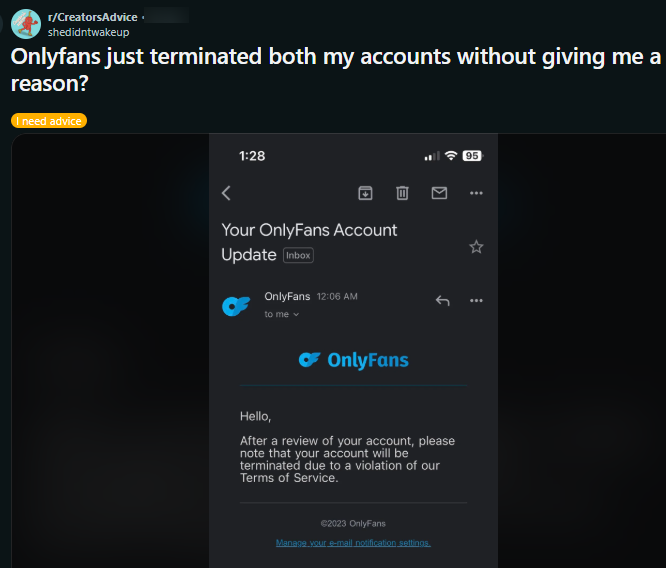
A platform suspension can disrupt subscriptions, content access, and revenue overnight. An independent OnlyFans alternative website gives creators a second revenue channel they control, reducing the risk of having their entire business tied to one account.
II. Poor Searchability & Discoverability
Building an audience on OnlyFans often depends on traffic coming from social media and external channels. A dedicated paid fan site creates another destination creators can optimize for search, build branded landing pages, and capture traffic beyond their OnlyFans profile.
III. High Platform Fees
At scale, platform fees stop being a minor cost. OnlyFans takes 20% of fan payments, according to its published terms. A creator generating $100,000 monthly would pay $20,000 in platform fees before other expenses. For high-earning creators, an independent fansite can be worth evaluating based on the potential savings and added control.
IV. Poor Customer Support & Delayed Payouts
When your income depends on a third party, support and payment issues become business concerns rather than occasional inconveniences. Running an independent fan site gives creators more control over billing, customer support processes, and how their revenue operations are managed.
V. Platform Restrictions & Content Moderation
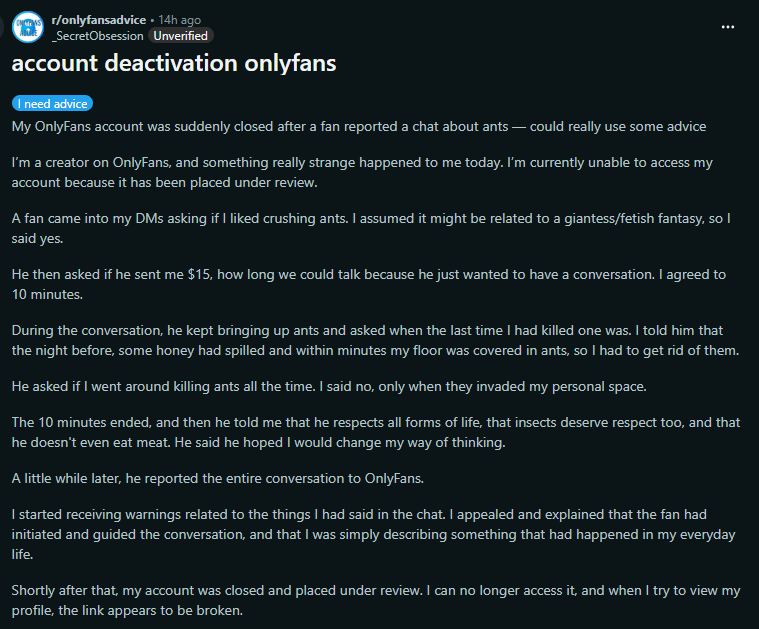
Creators have to operate within the platform’s content and account policies, which can change over time. A custom fan website doesn’t eliminate compliance requirements, but it gives creators greater control over their rules, moderation processes, and how content is managed.
VI. Limited Ownership & Control
OnlyFans can help creators build an audience, but the customer relationship still sits on the platform. An independent paid fan site gives creators greater control over pricing, branding, subscriber data, and monetization.
How to Launch Your Own Fan Site and Migrate From OnlyFans?
Building your own fan site requires a deliberate plan to move your audience, content, payments, and revenue without disrupting the business.
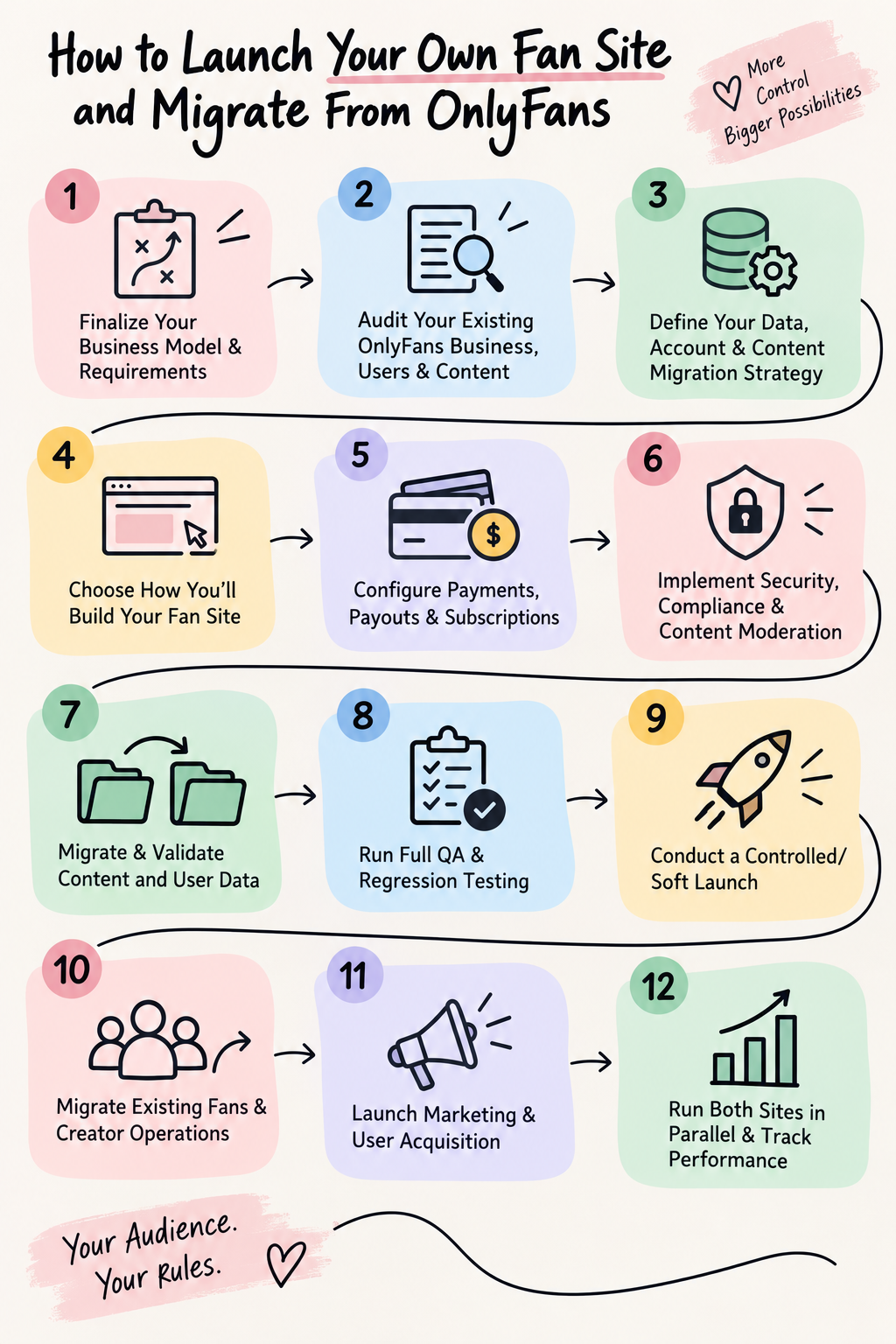
1. Finalize Your Business Model & Requirements
First, decide how the new fan site will make money. Will subscriptions remain the core offer, or will you add PPV content, paid messages, tips, livestreams, custom content, or premium memberships?
Set pricing, access levels, payment methods, and revenue targets based on what your audience already buys. Then define the features the site actually needs, such as creator profiles, subscriber accounts, content delivery, messaging, analytics, and admin tools.
2. Audit Your Existing OnlyFans Business, Users & Content
Before moving anything, get a clear picture of what is actually working. Review subscribers, revenue, subscriptions, PPV sales, messages, content performance, traffic sources, and engagement.
This helps you decide what needs to move, what needs cleaning up, and what should be improved. Third-party OnlyFans data tools document exports covering fans, transactions, chat messages, media, payouts, and other account data, making a structured audit valuable before migration.
Audit these areas:
- Active, expired, and high-value subscribers
- Subscription and PPV revenue
- Top-performing content
- Messages and fan interactions
- Traffic and conversion sources
- Pricing and promotional offers
- Content rights and ownership
- Data required for the new paid fan site
The objective isn’t to copy your OnlyFans account, it’s to identify what drives revenue, understand your audience, and carry those insights into a paid fan site built around what already works.
3. Define Your Data, Account & Content Migration Strategy
Once the audit is complete, decide how each piece of data will move to the new paid fan site. Subscriber records may need to be recreated, media libraries imported, and subscription or PPV information mapped to the new system.
Third-party tools such as OnlyFans API document exports for transactions, chat messages, media, fans, payouts, and other records, which can help structure the migration.
Plan the migration around:
- What can be exported and in what format?
- What needs to be recreated on the new site?
- How will existing subscribers be onboarded?
- How content will be mapped to new accounts and access levels?
- How will data be checked after import?
- What should be backed up or archived?
The goal is a clean transition without losing valuable data, breaking content access, or creating unnecessary work during the move.
4. Choose How You’ll Build Your Fan Site
Once the business model is clear, choose the build route that fits your budget, timeline, and level of customization. For an established creator, the practical options are usually a custom build or a ready-made adult software.
Consider:
- Custom development vs. ready-made software
- Features you need now vs. those you may add later
- Branding, domain, and design requirements
- Mobile experience and content delivery
- Admin, analytics, and moderation tools
- Upfront development and ongoing maintenance costs
If getting live quickly is the priority, ready-made software can shorten the development cycle. If the site needs a highly specific user experience or custom functionality, a tailored build may be the better investment.
For example, xModel by Adent.io is a ready-to-use adult fan site script that allows models and creators to launch their own website, monetize their content, and build direct relationships with their audience, all while managing their business on the go.
5. Configure Payments, Payouts & Subscriptions
Moving payments from OnlyFans to your own paid fan site means you’ll need to set up the billing and payout flow yourself. The key is choosing a payment setup that works with your content category, target markets, pricing model, and expected transaction volume.
Focus on:
- Choosing an adult-friendly payment processor
- Setting up recurring billing and subscription renewals
- Supporting PPV, tips, paid messages, and other purchases
- Defining creator payout schedules and minimum thresholds
- Handling refunds, disputes, and chargebacks
- Supporting your target currencies and countries
- Meeting age-verification, consent, and processor requirements
- Keeping a backup payment option where practical
Don’t make the decision based purely on transaction fees. Check the processor’s adult-content policy, supported countries, payout terms, reserve requirements, dispute process, and restrictions on recurring or high-value transactions. These details can have a much bigger impact on your revenue than a small difference in the advertised processing rate.
6. Implement Security, Compliance & Content Moderation
When you run your own paid fan site, you take responsibility for the security, compliance, and moderation processes that a platform like OnlyFans handles on your behalf. That means setting clear rules for who can join, what can be published, how consent is documented, and violations are handled.
Prioritize:
- Age and identity verification
- Performer consent and recordkeeping
- Secure authentication and payment data
- Privacy, data retention, & deletion policies
- Content reporting and moderation workflows
- Role-based access for admins and staff
- Fraud, abuse, and chargeback prevention
- GDPR and other applicable privacy requirements
The requirements will depend on where your site operates, where your users are located, and the type of content you publish. For example, GDPR can apply when you offer services to users in the EU and process their personal data.
The important distinction is that leaving OnlyFans does not remove compliance obligations, it transfers more of the responsibility to you. Your site should have documented processes for verification, consent, moderation, data handling, and responding to complaints before you begin moving users across.
7. Migrate & Validate Content and User Data
Move approved data in controlled batches and verify subscriber accounts, subscriptions, PPV purchases, content access, and media after each transfer. Check for missing, duplicated, corrupted, or incorrectly mapped records.
Keep the original data backed up until the new paid fan site is fully validated. Where GDPR applies, also account for data portability, retention, deletion, and transfer requirements.
The goal is a smooth transition without lost data, broken access, or subscriber disruption.
8. Run Full QA & Regression Testing
Before inviting paying subscribers, test your paid fan site as a live revenue channel, not simply as a completed website. Run through critical journeys such as signup, age verification, subscriptions, PPV purchases, messaging, payments, refunds, and content access.
Test the site across mobile devices and major browsers, while also checking payment failures, access permissions, broken links, notifications, security controls, and migrated data. Pay extra attention to anything that can directly affect revenue or subscriber access.
Fix critical issues before launch and repeat regression testing after major changes. The objective is simple: subscribers should be able to join, pay, and access their purchases without encountering issues.
9. Conduct a Controlled/Soft Launch
Don’t move your entire audience at once! Start with a smaller group of trusted subscribers, creators, or existing fans and use their behavior to identify friction before scaling the paid fan site.
Monitor signup conversion, subscription purchases, payment failures, content engagement, support requests, and churn closely. Use those insights to refine pricing, onboarding, checkout, and the overall fan experience before inviting your wider OnlyFans audience.
The objective here is simple; to prove the business works at a smaller scale before putting your full-fledged audience behind it.
10. Migrate Existing Fans & Creator Operations
Once the paid fan site is tested and ready, begin moving your existing audience through your established communication channels. Make the transition worthwhile with clear messaging, incentives, or early-access benefits rather than simply asking fans to create another account.
At the same time, shift day-to-day creator activities to the new platform, including publishing, messaging, subscription management, PPV sales, fan support, and performance tracking. Make sure creators and staff understand the new workflows and account permissions before the wider audience is onboarded.
The priority is to retain existing fans while making the new site practical to manage, monetize, and grow.
11. Launch Marketing & User Acquisition
Your existing audience should be the first source of traffic for the new paid fan site. Use your established social channels, email list, direct fan communication, collaborations, and search to introduce the site and give existing followers a clear reason to join.
A pre-launch campaign can build awareness, while introductory offers, referral incentives, and targeted promotions can help convert early visitors into paying subscribers.
SEO can drive steady organic discovery, while retargeting helps creators re-engage visitors who viewed their content or pricing but left without subscribing. Together, they create an acquisition loop that continues well beyond the initial launch.
Track more than traffic as in like monitor subscriber acquisition, conversion rates, retention, and lifetime value to identify which channels are actually generating profitable, long-term customers.
The goal is not simply to announce the new site, it is to build a repeatable flow of visitors and paying subscribers.
12. Run Both Sites in Parallel & Track Performance
There is no need to shut down your OnlyFans account immediately. Running both channels in parallel gives you a clear window to compare performance and understand how much revenue your own paid fan site can realistically generate.
Track subscriber growth, conversion, churn, revenue per subscriber, PPV sales, payment success, engagement, and acquisition costs across both platforms. Look beyond topline revenue and compare how much you actually retain after platform fees, payment costs, promotions, and other operating expenses.
Use these results to identify where your audience responds best and decide whether to keep both channels active, shift more subscribers to your own site, or gradually reduce your reliance on OnlyFans.
How Creators Monetize Their Own Paid Sites?
A paid fan site gives creators the opportunity to earn from the same audience in several ways, rather than limiting revenue to a monthly subscription. The right mix depends on fan spending behavior, content type, and how much premium access they are willing to pay for.
- Membership Tiers – Create different access levels for fans with different spending preferences. Higher tiers can include exclusive content, priority interaction, early access, or other premium benefits.
- PPV Content – Sell individual photos, videos, collections, or special releases alongside subscriptions for additional revenue.
- Tips & Paid Messages – Let fans pay for direct interaction, personalized replies, or premium conversations.
- Content Bundles & Limited-Time Offers – Package related content or create limited-time drops to encourage additional purchases without permanently reducing subscription prices.
- Custom Content – Offer personalized photos, videos, shout-outs, or other permitted requests at premium prices with clear terms and turnaround times.
- Merchandise – Extend the creator brand through clothing, accessories, signed products, and limited-edition merchandise.
- Livestreams – Monetize live sessions through paid access, tips, premium rooms, or exclusive events.
- Premium/VIP Access – Package high-value benefits such as exclusive content, private livestreams, early access, and priority interaction into a premium offering.
- AI-Powered Fan Experiences – AI can add another paid engagement layer through personalized chat, interactive experiences, or usage-based features. Clearly disclose AI involvement, especially when a creator’s likeness, voice, or persona is involved.
What Does It Cost to Run Your Own Creator Fan Site?
The cost of launching a paid fan site depends on how much customization you need and how quickly you want to go live. A custom build can range from $15,000 – $45,000+ depending on design, features, integrations, and development requirements.
For creators who don’t need a fully custom build, xModel by Adent.io offers two packages. xModel LITE is currently priced at $199 as a one-time license, while Premium pricing is available on request. This can significantly reduce the upfront development cost compared with building a platform from scratch.
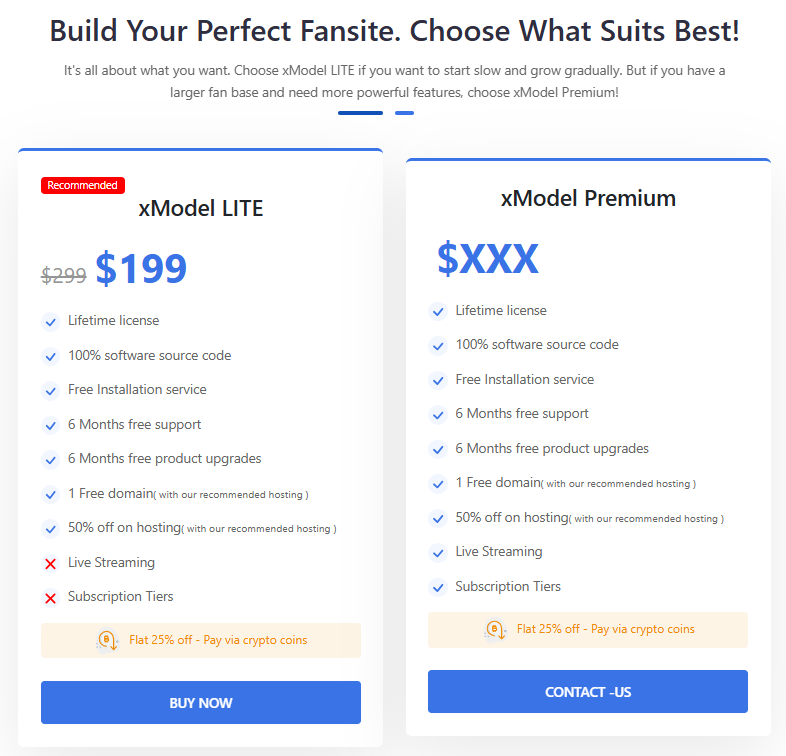
Custom development, on the other hand, costs more but gives you greater freedom over the site’s design, workflows, integrations, and features.
Beyond the initial build, plan for around $300 – $2,000+ per month for hosting, video storage and delivery, maintenance, security, technical support, and third-party services. High traffic, large video libraries, livestreaming, and extensive customization can push ongoing costs higher.
Payment processing, marketing, moderation, and age-verification services are additional expenses and will vary based on usage and transaction volume.
Final Thoughts
Leaving OnlyFans doesn’t have to mean abandoning the audience or revenue you’ve already built. For established creators, launching a paid fan site can be a strategic way to diversify revenue, strengthen the direct relationship with fans, and reduce reliance on a single platform. The right approach depends on your audience, budget, technical requirements, and growth plans. Whether you choose custom development or a ready-made adult software, the priority should be a smooth migration and a monetization model built for long-term growth.
FAQs On Top Creators Launch Their Own Paid Sites
1. What happens to existing OnlyFans subscriber data during migration?
Migration depends on what data is accessible and legally transferable. Subscriber records, content, purchases, and engagement data may require different handling, recreation, mapping, or retention decisions.
2. What should creators evaluate before choosing a fan site script?
Evaluate monetization features, payment compatibility, content management, scalability, customization, security, analytics, mobile experience, ownership terms, technical support, and the total cost of running the platform.
3. Should creators recreate their entire OnlyFans content library on the new site?
Not necessarily. Prioritize high-performing and commercially relevant content, then organize older material based on demand, rights, storage costs, and the experience you want to create for subscribers