


The internet’s long-standing “honor system” for adult content, a checkbox confirming you’re 18, is officially over. For years, platforms relied on self-declaration to gate explicit material. Now, regulators across the globe have made one thing clear: that system failed.
As of 2026, age verification laws for adult websites are no longer theoretical. They are active, enforced, and rapidly expanding. More than 25 US states, along with countries like the UK, France, Germany, Italy, and Australia, now require platforms to implement verifiable age checks before granting access to adult content.
The legal debate reached a turning point in 2025, when the Supreme Court of the US upheld the authority of states to enforce age verification requirements. Since then, enforcement has escalated as fines are being issued, platforms are blocked, and compliance failures are increasingly visible.
This guide breaks down:
- Current age verification requirements for adult websites
- Accepted age verification methods
- State-level age verification laws and global enforcement
- Penalties for non-compliance
- Future trends in international adult website compliance
Whether you run an porn website, consume content, or simply want to stay ahead of the legal curve, here is everything you need to know.
What Is Age Verification for Adult Websites?
Age verification is the process of proving a user meets the legal minimum age (typically 18) before granting access to restricted content.
This is not the same as age estimation.
- Verification = definitive check (ID, database, government credential)
- Estimation = AI-based guess (facial analysis, probability)
The distinction is critical.
Most jurisdictions now require verification, not estimation. A system must confirm age against a trusted source, not predict it. Self-declaration (entering a birthdate or ticking a box) is no longer compliant in any serious regulatory framework.
What Content Falls Under These Rules?
The scope of age verification laws for adult websites is expanding rapidly.
Core categories:
- Pornographic websites
- Cam and live-streaming platforms
- Adult video-on-demand services
- User-generated platforms hosting explicit content
Expanding categories:
- Dating apps
- Online gambling platforms
- Mature/violent gaming environments
- Algorithm-driven platforms where minors could encounter harmful content
The direction is clear: If minors can access it and it poses risk, it’s moving toward regulation.
Why Are Governments Enforcing Strict Age Checks for Adult Sites?
The shift from voluntary to mandatory is evidentiary. Three factors are driving enforcement:
- Documented minor exposure: Research shows children in the US & UK are getting their first smartphones around age 11, enabling unfettered access to explicit content years before they’re developmentally ready.
- Legal liability pressure: Child safety organizations and lawmakers have successfully argued that platforms profiting from adult content bear the same duty of care as physical retailers selling age-restricted goods like alcohol or tobacco.
- Alignment with offline law: Regulators frame online age checks as the digital equivalent of ID checks at a liquor store or cinema. The 2025 Supreme Court ruling adopted this framing directly, applying intermediate scrutiny rather than the stricter First Amendment review that platforms had relied on to block earlier laws.
Key Global Updates: 2025 – 2026 Snapshot
Age verification is now mandatory across all major internet markets. The technical bar is rising from basic ID uploads to “highly effective age assurance” systems, a phrase used by both the UK’s Ofcom and the EU’s Digital Services Act guidance. Key cross-border developments:
1. United Kingdom
The Online Safety Act 2023 took full effect on July 25, 2025, requiring all services hosting pornographic content to use age verification or estimation to prevent children from accessing it.
Ofcom can impose penalties of up to 10% of global revenue or £18 million, whichever is greater. Playboy was fined £60,000 after children were found accessing adult content through inadequate age checks, and investigations into 20 further porn sites are active.
2. United States
More than half of US states have passed laws requiring porn sites to verify users’ ages, with states like Louisiana, Utah, Texas, Tennessee, and Virginia leading the wave.
Louisiana’s Act 440 assigns civil penalties of up to $10,000 per day for non-compliance, and Arizona’s law allows courts to impose fines up to $250,000 if a minor actually gains access due to verification failure.
3. Australia
Australia started imposing stricter age verification rules on March 9, 2026, requiring users to prove they are over 18 before accessing platforms hosting adult content.
Phase1 in December 2025 banned under-16s from major social platforms including TikTok, Instagram, and YouTube. Phase 2 in March 2026 extended this to porn sites, AI chatbots, and device makers. Platforms that fail to take reasonable steps face fines up to AUD 49.5 million. Pornhub simply blocked Australian users entirely rather than comply.
4. Europe
France’s regulator Arcom brought its age verification rules into effect on January 11, 2025, and Italy’s AGCOM followed in May 2025 formally approving robust age verification requirements for adult content platforms.
The EU Commission released a prototype age verification app currently being piloted in Denmark, France, Greece, Italy, and Spain, ahead of the full EU Digital Identity Wallet launch in 2026.
Germany tightened enforcement in December 2025, where regulators can now go beyond blocking websites and require banks and payment providers to stop processing payments for non-compliant platforms..
Types of Age Verification Methods Used for Adult Sites
Regulators don’t lock adult sites into one method, but they do expect high assurance and privacy protection. The smartest platforms layer multiple methods to stay compliant and user-friendly.
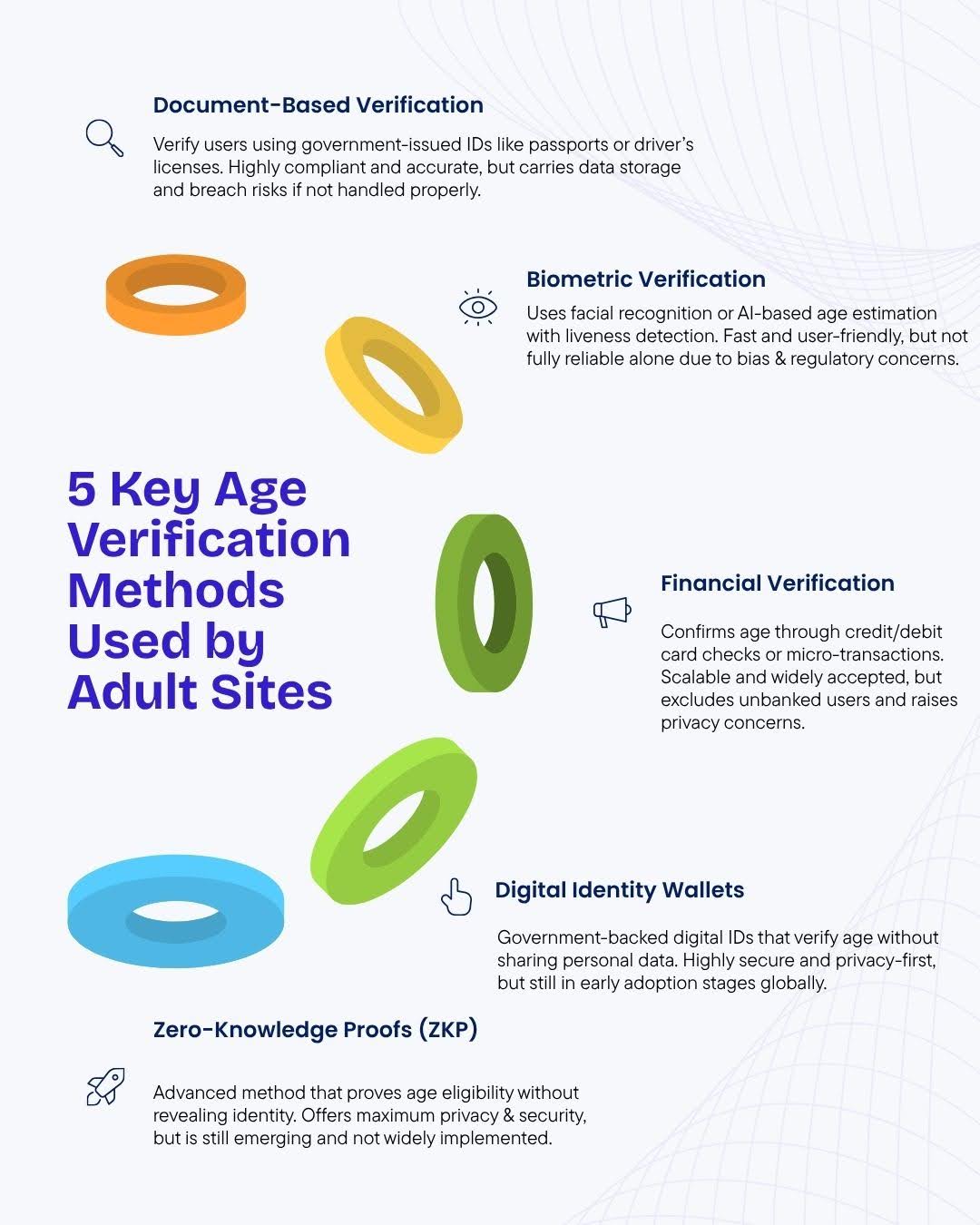
1. Document-Based Verification
This is the most legally bulletproof method, users upload a government-issued ID like a passport or driver’s license, and a third-party provider validates authenticity and confirms age in real time.
Jurisdictions like the US, UK, and Australia accept it as compliant. The catch here is, centralized ID storage is a data breach waiting to happen. Most regulations now mandate immediate deletion of ID images post-verification, but enforcement of that deletion is inconsistent. If you’re a platform using this method, your vendor choice is everything.
2. Biometric Verification
Facial recognition matching a live selfie to an uploaded ID photo is gaining serious traction, and AI-based age estimation predicting age purely from facial features without any document is increasingly accepted as a secondary layer.
Both methods require liveness detection to defeat deepfakes, and the tech is genuinely improving fast. And despite the progress, there’s a regulatory red flag, studies from NIST show bias risks due to underrepresentation of certain ethnic groups in training datasets, raising real concerns around discrimination and accountability.
So, biometrics alone won’t satisfy compliance in most jurisdictions; it needs to be layered with another method.
3. Financial Verification
Credit or debit card checks remain one of the most universally accepted methods across jurisdictions. A temporary micro-authorization confirms the cardholder is an adult without storing sensitive financial data long-term. It’s frictionless, scalable, and broadly legally compliant.
The blind spot: it excludes millions of legitimate adults who don’t hold credit cards, younger adults, unbanked populations, and people in developing markets. It also creates financial data trails that privacy advocates flag as a surveillance vector. Works well as part of a multi-layered approach, not as a standalone solution.
4. Digital Identity Wallets
This is where the industry is heading and fast. Government-backed digital ID wallets issue a signed age credential that a website simply checks, without ever receiving any personal data.
The EU Digital Identity Wallet is being developed under the EUID framework and is set for full release by the end of 2026, with an interim mini-wallet already piloting across France, Denmark, Greece, Italy, and Spain. Australia has its own Digital ID system, and the UK’s DIATF-certified framework is evolving rapidly.
5. Zero-Knowledge Proofs
ZKP is the most sophisticated and privacy-preserving method available today. Google Wallet integrated ZKPs via its Digital Credentials API so users can verify their age without disclosing identity and has open-sourced the technology, with Bumble among the first major platforms to accept these proofs.
Apple followed in February 2025 with updated age-assurance measures aligned with W3C standards, and Google’s parallel framework supporting ZKP age signals launched in March 2025. France’s data protection authority CNIL has formally acknowledged ZKP as a privacy-friendly model and now requires adult content sites to offer at least one double-blind option meaning the platform doesn’t even know what site the user is verifying on.
Ofcom has confirmed ZKP-based methods are compliant under the UK’s Online Safety Act. The bottom line: platforms receive a simple binary yes/no answer, no name, no document, no data trail.
Compliance Requirements for Adult Websites
Across all major jurisdictions, compliant age verification must satisfy four criteria:
- Pre-Access Gating: Age must be verified before any restricted content is displayed, not after sign-up, not on a per-video basis.
- Immediate Data Deletion: ID scans, selfies, and biometric data must be deleted immediately after verification completes. Retaining this data is itself a separate, penalizable violation in Texas, Arizona, and under GDPR.
- Third-Party Verification: Most laws prohibit self-certification. A qualified third-party provider must conduct the check. Florida mandates Florida-issued ID processed by a third party.
- Audit Trails: Platforms must be able to demonstrate to regulators that their verification system is functioning, without retaining user-identifiable records.
Leading third-party providers include Yoti, AgeID, Persona, Incode, Sumsub, and Jumio.
Note: In February 2026, Sumsub disclosed an 18-month-old data breach, underscoring that vendor due diligence is not optional.
What’s Next: 2026 and Beyond
The momentum shows no sign of slowing. Bills pending in 16 additional U.S. states would bring the total well past 30.
Another most significant emerging shift is device-level and app-store-level verification. Rather than every individual website running its own checks, states including Utah, Michigan, Illinois, and California are placing the obligation on operating systems and app stores directly.
Utah’s App Store Accountability Act (SB 152) is the first US law to impose age verification obligations on app store operators like Apple and Google, not individual apps.
California’s Digital Age Assurance Act (AB 1043), signed in October 2025, takes a device-centric approach: age is confirmed when a user account is first created on a device, not at the point of accessing specific content. The verify-once, use-everywhere model is the architecture 2026 is building toward.
Final Thoughts
The checkbox era is over. What replaces it and how that replacement balances child safety against adult privacy, free expression, and digital security will define the shape of the internet for years to come.
What is clear today is that compliance is no longer optional. Now, the question is no longer whether age verification will be required, but which methods will prove both effective and privacy-respecting enough to earn broad public trust. For adult entrepreneurs: consult legal counsel to understand which laws apply to your platform, and evaluate third-party verification providers carefully. For users: understand your state’s law, know your privacy rights, and stay informed as this landscape continues to shift.
FAQs Regarding Age Verification Laws For Adult Websites
1. Do free adult websites have to comply with age verification laws, or just paid platforms?
Yes, free platforms are equally liable. Laws target any site hosting explicit content accessible to users, regardless of whether it charges a subscription. Free platforms like Pornhub face the same obligations as paid services.
2. Can adult websites be held criminally liable if a minor bypasses verification?
Yes, in several states. Tennessee classifies non-compliant platforms as Class C felony offenders. Having a documented, functioning compliant system is your primary legal defense against criminal exposure.
3. Are adult gaming and hentai platforms subject to the same verification laws?
Yes, increasingly. Australia’s Phase 2 rollout explicitly included mature gaming environments, and the UK’s Online Safety Act covers animated and illustrated explicit content, not just live-action pornography.