
TL;DR
- You should choose a white-label webcam platform if you want a lower upfront investment, faster time to market, and a ready-to-launch platform within a few days or weeks.
- Go for custom webcam platform development if you are looking for complete ownership and highly customized features. In short, if you want to build a platform for your long-term, unique business vision.
- Compare more than just the initial cost. Evaluate development time, scalability, security, maintenance, ownership, and the total cost of ownership (TCO) before making a decision.
- Remember that not all white-label webcam software is the same. Compare vendors based on customization capabilities, source code ownership, technical support, security, pricing, and long-term scalability.
- This guide compares white-label webcam software and custom webcam software development across development cost, time to market, customization, scalability, security, maintenance, and ownership to help you choose the right solution for your business.
- One of the biggest decisions you’ll make while starting your webcam business is how you’re going to build your platform. You have two options: investing in white-label webcam software or choosing custom webcam platform development.
Each approach comes with its own advantages and trade-offs in terms of cost, time to market, customization, scalability, security, maintenance, and long-term ownership.
This guide compares white-label webcam software and custom webcam platform development across these key factors, helping you understand which approach best aligns with your business goals, budget, and long-term vision.
What Is White Label Webcam Software?
White-label webcam software is pre-built and ready-to-launch webcam software that allows you to launch your own webcam business without having to develop the entire platform from scratch.
It comes with the core features required to get started and can be customized to match your brand, design, and business requirements. By choosing a white-label solution, you can significantly reduce development time and launch your platform much faster than with custom development.
Before investing, ask your provider about the adult webcam software’s capabilities, features, and customization options.
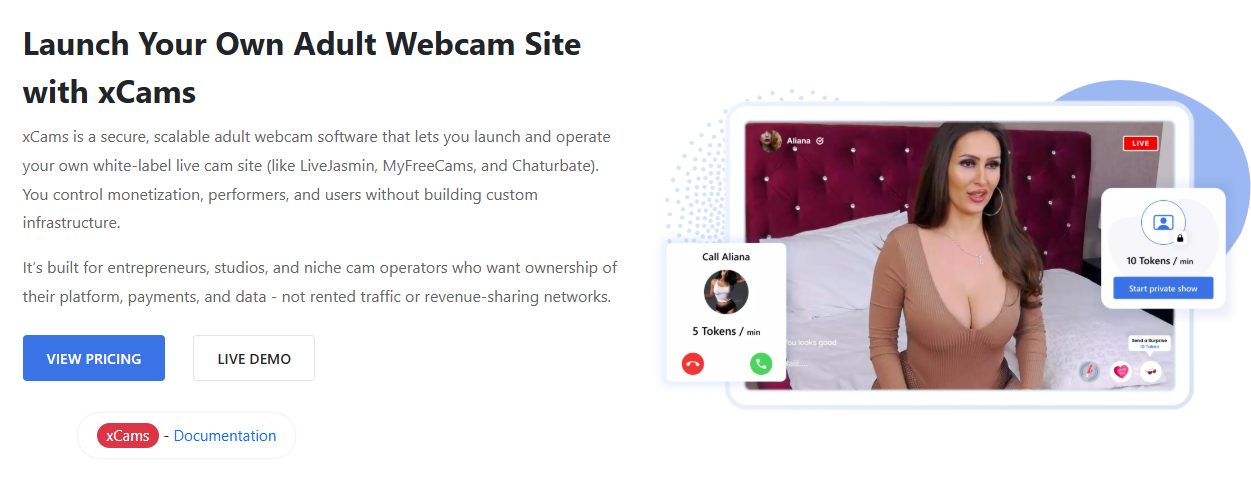
For example, Adent’s adult webcam software is designed for entrepreneurs, startups, and businesses looking to launch and scale their own webcam platforms. It enables you to build feature-rich websites similar to LiveJasmin or Chaturbate.
What is Custom Webcam Platform Development?
Custom webcam platform development is the direct opposite of purchasing white-label webcam software. In this approach, you design, develop, and launch a webcam business completely from scratch.
Unlike the previous approach, where a set of things is already pre-built and ready to use, every single feature from the top to the bottom is specifically built for your business. This includes the platform’s features, how the user experience is designed, and the roadmap as well.
The biggest advantage of building a custom adult webcam website is complete ownership.
Though the development timelines are longer and require an experienced adult development team, it gives you the flexibility to tweak and customize the platform as you wish.
That doesn’t mean white-label webcam software doesn’t offer complete ownership. However, the level of ownership and customization can vary from provider to provider.
White-Label Webcam Software vs. Custom Development: A Detailed Comparison
In this section, we’ll cover the differences between the two approaches over various aspects like development cost, time to market, customization and branding, scalability, security and compliance, and more.
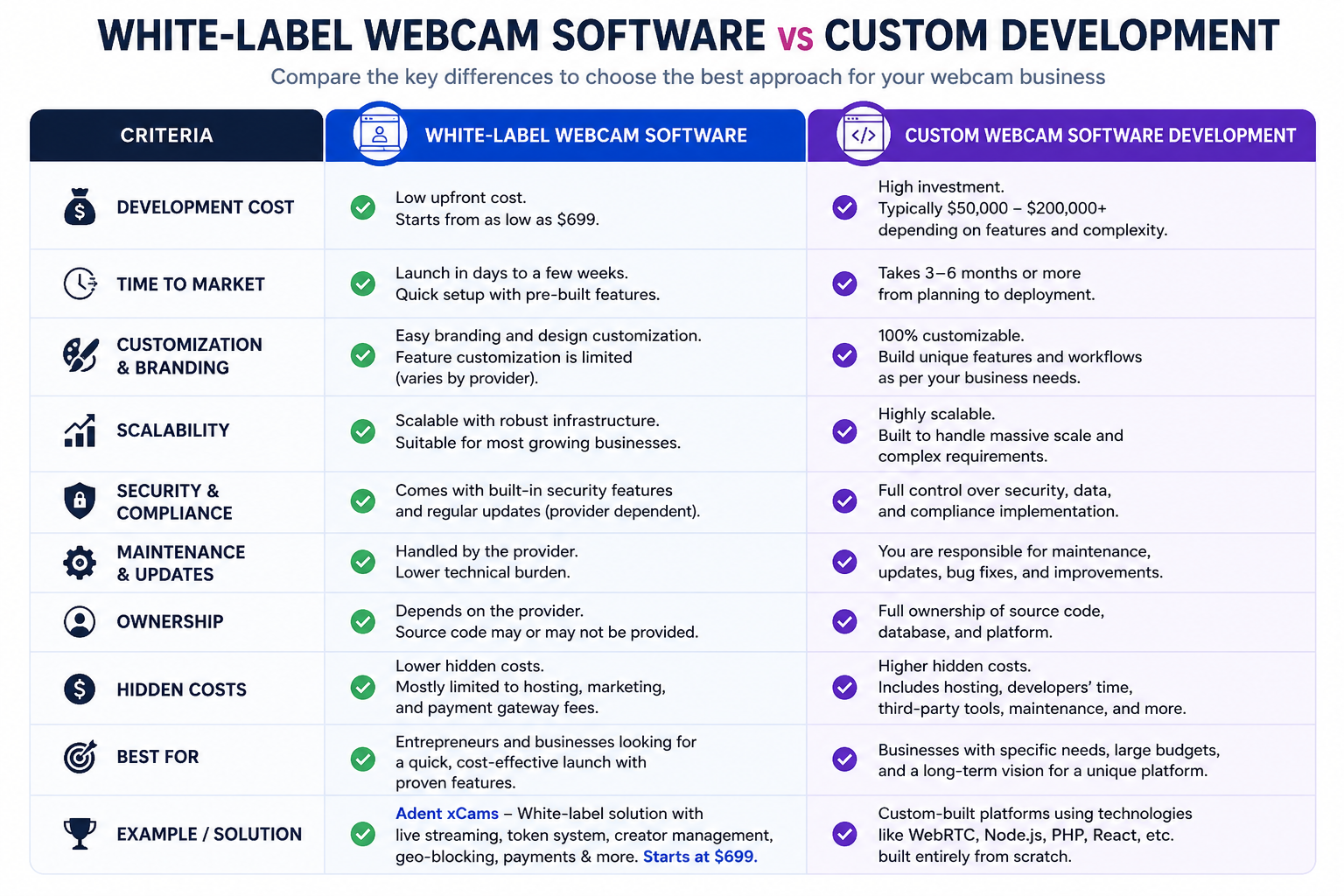
But before that, here’s a high-level overview of what you’re going to see.
a. Development Cost
The development cost is usually one of the important factors, especially if you are starting out new, solo, or with a low investment. While in both approaches you launch a webcam platform, the upfront investment required for each differs significantly.
The reason is quite simple. A white-label webcam software is already built. But when you build it from scratch, it involves hours of development, testing, and optimization. When choosing white-label webcam software, you only pay for the licensing fees and any additional customization costs, instead of funding the entire development process.
The table below provides a high-level comparison of the typical investment required for each approach.
| Cost Factor | White-label webcam software | Custom webcam software development |
| Upfront investment | Starts from $699 (varies based on the vendor, customization, and licensing costs) | Starts from $50,000–$200,000+. Varies depending on features and development complexity |
| Development timeline | A few days to several weeks | 3 – 6 months, or even longer |
| Core features | Already built, and comes out of the box | All features are built from the ground up. |
| Infrastructure setup | Hosting services are generally included in the package. | Deployment requires technicians and a separate cost. |
| Recurring costs | Licensing, hosting, and optional customizations | Hosting, maintenance, feature development, infrastructure, security updates, and technical support |
The white label webcam software is a clear winner here. But it would be misleading to just make a decision based on the upfront development cost. As a business owner, you should also take into account the Total Cost of Ownership (TCO) during the entire lifetime of the business.
A custom-built solution requires time-to-time investment in infrastructure, security patches, feature enhancements, and more. Similarly, a white-label platform may have recurring license fees (not all, though), support plans, and optional customization costs if needed. It is important to analyze the different cost factors before making a decision.
b. Time to Market
Like development costs, time to market is another critical factor when launching a webcam business. If your goal is to launch a webcam business quickly, then white label webcam software is the clear winner here. Since the software is pre-built, all that is needed is branding, customization, and deployment.
Whereas with custom webcam platform development, the entire journey starts from scratch, and every stage requires a brief pause. A few to mention are requirement gathering, design finalization & development, testing, and deployment. All of this can take a few months, or even close to a year.
| Timeline | White-label Webcam Software | Custom Webcam Software Development |
| Requirement gathering | The need is more or less the same. So, only a few days. | 2-3 weeks, as it requires requirement gathering, planning, and research |
| Design & Branding | A maximum of 1 – 3 weeks since the UI already exists. | 4 – 8 weeks since UI/UX has to be designed from scratch. |
| Feature Development | Core features of webcam software are pre-built and ready to use, enabling a faster launch without extensive development | 2 – 6 months, or even more. |
| Testing & Deployment | Very minimal because the software is already tested & deployed several times. | Several weeks |
| Estimated Time to Launch | A few days to a month. | 3 – 6 months, or even longer |
Most businesses that look to start a webcam business lean towards white label webcam software because they look to validate their business idea in the early stages. But if you are someone looking to create something with highly customized workflows and trying to give users a unique experience, then the development timeline shouldn’t be on your list of priorities.
c. Scalability
Everyone thinks scalability is about how many users the website or the platform is capable of handling. While that is there, it also means how well your business can adapt to changing trends. For example, if you want to introduce a new monetization model or integrate an additional service, can your platform accommodate those changes with ease?
From a technical standpoint, both white-label webcam software and custom webcam software development can be highly scalable when implemented correctly. The difference lies in how that scalability is achieved.
A well-developed white-label platform is built to support multiple customers and is often optimized to handle increasing traffic. As your business expands, you can scale by upgrading your hosting infrastructure or moving to powerful cloud resources. However, the ability to introduce major changes depends on the vendor and the level of customization they offer.
The comparison below highlights the key differences.
| Factor | White-label Webcam Software | Custom Webcam Software Development |
| Audience growth adaptation | Infrastructure upgrades to support the growing base | Traffic is projected in the early stages and built accordingly. |
| Live streaming | Largely dependent on hosting and platform architecture | Optimized according to business requirements. |
| Feature development | Based on the vendor’s customization options | Any kind of new feature can be introduced |
| Third-party integrations | Depends on third-party APIs and vendor support | Can be integrated with any service provider |
| Long-term flexibility | Moderate; depends on the vendor | Very high |
If starting a typical webcam business is your goal and you don’t need a lot of innovations, at least during the early stages, you should be good with white-label webcam software. Unless and until there is a revolutionary change in the industry, you don’t have to revamp your platform, which is unlikely to happen. Even if you need some changes or feature additions, your vendor should be able to accommodate them comfortably.
If you are just starting, a well-developed white-label webcam software should serve the purpose. Because the wise thing to do would be to assess the market quickly, with very little investment.
d. Security and Compliance
Security is not exclusive to either white-label or custom development. The level of security your webcam platform offers ultimately depends on how it is built, maintained, and updated over time.
With white-label webcam software, the provider is typically responsible for releasing security patches, fixing vulnerabilities, improving platform stability, and keeping the software updated with evolving security standards. However, this largely depends on choosing an established provider that offers regular updates and ongoing technical support.
In custom webcam platform development, businesses have complete control over their security strategy. This allows them to implement security measures tailored to their requirements, but it also means taking responsibility for regular updates, vulnerability management, and long-term maintenance.
Regardless of the approach you choose, your webcam platform should follow security best practices such as encrypted data transmission, secure payment processing, and regular security assessments.
Security is not a one-time implementation but a continuous process that evolves alongside your platform and its users.
e. Maintenance and Technical Support
Launching your webcam platform is only the beginning. After that comes the maintenance and technical support. As your user base grows and new technologies emerge, regular maintenance becomes essential to ensure performance, security, and reliability.
When choosing a white-label webcam software, the vendor usually gives extended support, introducing continuous updates to the platform. Even if you encounter any technical issues, you can rely on the vendor to diagnose and resolve them. Since you are at the early stages, you can focus on marketing and growth without worrying about the operational burden.
When choosing custom webcam software development, your service provider may provide post-launch support for an agreed period, but long-term maintenance eventually becomes your responsibility.
This is one of the reasons many startups and first-time entrepreneurs choose white-label webcam software. Solutions like Adent’s xCams, for example, include post-launch technical support, allowing businesses to resolve issues quickly without managing every technical aspect themselves.
f. Ownership & Flexibility
One of the biggest differences between white-label webcam software and custom webcam software development is who owns the platform after it goes live.
When choosing a white-label webcam software, ownership varies from one vendor to another. With some vendors, you can simply license the software, but you don’t own the underlying source. Others, like Adent.io, offer full ownership of the source code, allowing you to customize the software extensively while launching it under your own brand.
When you choose custom webcam site development, you typically own every aspect of the platform. You can modify the software as per your wish and introduce new features, without dependency.
There isn’t a universally better option. If your goal is to launch a proven business model quickly and focus on acquiring creators and users, a white-label webcam software solution will meet the needs of most businesses. If your long-term vision involves building a highly differentiated platform, custom webcam software development provides the ownership and flexibility needed to support that vision.
Hidden Costs Webcam Businesses Often Overlook
When choosing between the two approaches, businesses focus only on visible expenses such as licensing fees or development. Several hidden costs go unnoticed, which is what we’ve unraveled in this section, as these can significantly impact your budget after launch.
1. Infrastructure & Hosting Costs: Irrespective of any approach you choose, as your traffic scales, storage requirements increase along with your hosting costs. The cloud server cost, CDN services, and backup system should also be factored into your long-term budget.
Depending on your traffic volume and hosting provider, infrastructure costs can range anywhere from $50–$300/month for a new platform to over $2,000/month for over a thousand users
2. Payment Gateway & Transaction Fees: The payment gateway service provider charges transaction fees. Along with this, chargebacks, refunds, and payment processing fees can also become significant operational expenses.
The payment processing fees are typically higher for adult businesses, ranging between 8% and 15% per transaction depending on the payment provider. Also, chargeback fees may add another $20–$100 per disputed transaction.
3. Customization & Feature Requests: Every additional customization or feature request you ask for comes with an additional cost. This depends on the charges provided by your service provider, based on their billable hours.
Simple UI changes may cost only a few hundred dollars, while custom features, third-party integrations, or AI-powered functionality can range from $1,000 to $20,000+. And it also largely depends on the complexity of the requirement.
4. Marketing & User Acquisition: After launching your webcam business, your platform needs visibility. For this, you’ll need to invest in SEO, paid ads, influencer collaboration, and more to attract users and creators. This requires a significant investment, depending on the level at which you want to market your platform.
Marketing budgets can range anywhere from $500 to $5,000 per month during the initial growth stage, depending on your target audience, marketing channels, and growth objectives. Businesses looking to scale faster often invest more in paid advertising, affiliate programs, creator acquisition, influencer marketing, and SEO.
5. Ongoing Maintenance: Even after the launch, your webcam business requires continuous software updates, security patches, and optimization at the server & performance level, all of which requires man power. This cost is inevitable, no matter which method you choose to start a webcam business.
Depending on the size of your platform, ongoing maintenance can cost anywhere from $500 to $5,000+ per month. This is inclusive of covering software updates, infrastructure monitoring, security improvements, and technical support.
Conclusion
Choosing between white-label webcam software and custom webcam platform development ultimately comes down to your business goals, budget, and long-term vision. If your priority is to launch quickly with a lower upfront investment, a white-label solution is the practical choice. If you need complete ownership, highly customized features, and full control over your platform, custom development is worth the investment. Before making a decision, evaluate factors such as development cost, scalability, security, maintenance, and flexibility. If you’re looking for a production-ready solution, explore Adent.io’s webcam software to launch and scale your webcam business with confidence.
FAQs Relevant to White Label Webcam Software vs. Custom Development
1. Is white-label webcam software better than custom webcam development?
White-label webcam software is ideal for businesses that want to launch quickly with a lower upfront investment and minimal technical complexity. Custom webcam site development is better suited for businesses that require complete ownership, highly customized features, and full control over the platform’s architecture.
2. How long does it take to launch a webcam website?
With white-label webcam software, businesses can typically launch within a few days to several weeks after branding and configuration. A custom-built webcam platform, however, generally takes 3 to 6 months.
3. Can I customize white-label webcam software?
Yes. Most white-label webcam platforms allow you to customize your branding, domain, design, payment gateways, and certain platform features. However, the level of customization varies from one provider to another.
4. How much does it cost to build a webcam platform?
The cost varies based on the development approach. White-label webcam software typically starts at around $700 to $1,000, while custom webcam platform development usually starts at $50,000 and can exceed $200,000, depending on the platform’s features and complexity