
TL;DR
- White label AI companion apps are best for businesses that want to launch quickly, minimize upfront costs, and validate their idea with a ready-to-market solution.
- Custom AI companion development is ideal for businesses seeking complete ownership, advanced customization, AI flexibility, and long-term scalability.
- Your decision should be based on key factors such as budget, time to market, product control, integrations, scalability, maintenance, and future business goals, not cost alone.
- There is no one-size-fits-all solution. White label accelerates market entry, while custom development provides greater freedom to innovate and differentiate over time.
- Whether you choose a white label or custom AI companion app, Adent.io delivers advanced AI adult website design, development, and software services to bring your vision to life
The AI companion market has moved from novelty to a genuine business category, with founders, agencies, and adult platform brands racing to launch their own branded chat experiences.
The biggest decision every team faces before writing a single line of code is whether to license a white label AI companion app or invest in custom development. This choice shapes your launch timeline, budget, ownership rights, and long-term ability to compete.
Pick wrong, and you either burn cash building something a ready-made solution already solves, or you get locked into a rigid platform that caps your growth. This guide provides a practical comparison of white label AI companion app vs custom development, explaining how both approaches work, where each excels, and which option is best suited for different business goals.
What Is a White Label AI Companion App?
A white label AI companion app is a ready-made AI chat platform that businesses can license and launch under their own brand. Instead of developing the software from scratch, you receive a fully functional product that already includes AI conversations, character management, user authentication, subscription features, and other core capabilities.
Your role is primarily to customize the branding by adding your company name, logo, domain, color scheme, and pricing plans. This significantly reduces both development time and upfront investment, allowing businesses to enter the market much faster.
White label solutions are particularly attractive for startups and entrepreneurs who want to validate demand, generate revenue quickly, or launch an AI companion business without assembling an in-house engineering team.
What Is Custom AI Companion App Development?
Custom AI companion app development involves building an AI platform specifically for your business rather than licensing an existing solution. Every component from the AI behavior and conversation flow to memory management, subscription logic, and user experience is designed around your product vision and business objectives.
Unlike white label software, there are no predefined limitations or vendor-controlled features. Although custom development requires greater investment, a longer timeline, and a dedicated technical team, it provides complete flexibility to create unique user experiences that competitors cannot easily replicate.
This approach is ideal for companies that view AI as a core competitive advantage rather than simply another feature.
White Label AI Companion App vs Custom Development: Complete Comparison
Choosing between a white label AI companion app and custom development is not simply about cost or launch speed. The decision affects product flexibility, business ownership, future upgrades, customer experience, and your ability to compete as AI technology evolves.
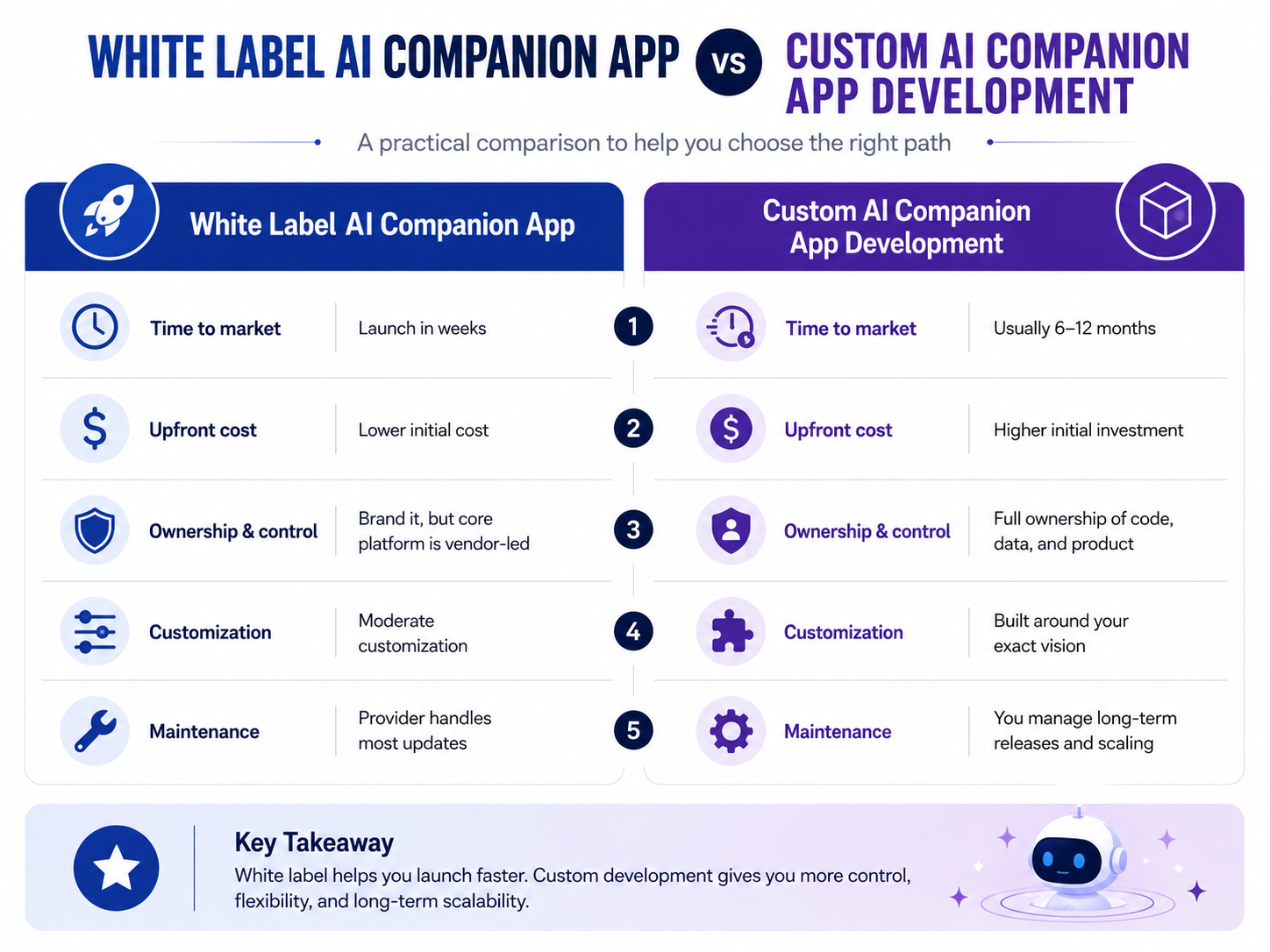
Below is a practical comparison across the factors that matter most when evaluating white label AI companion app vs custom development.
1. Time to Market
Launching quickly can be a major competitive advantage, particularly for startups testing product-market fit or businesses entering a rapidly growing market.
With a white label AI companion app, much of the work has already been completed. Core features such as user authentication, AI chat, subscriptions, payment processing, user dashboards, and admin controls are already available. Businesses mainly focus on branding, configuring AI personalities, integrating preferred AI models, and performing final testing before launch. Depending on customization requirements, deployment can often be completed within a few weeks.
Custom development follows a much longer timeline of 6-12 months because every feature is designed, developed, tested, and refined specifically for the product. Teams must define product requirements, create user flows, develop core functionality, conduct quality assurance, and prepare the application for production.
If validating a business idea quickly is the priority, white label software offers a clear advantage. If the goal is building a differentiated product with unique capabilities, the additional development time often becomes a worthwhile investment.
2. Upfront Investment vs Long-Term Cost
White label solutions generally require a lower upfront investment because the software already exists. Businesses typically pay a licensing fee, subscription, or one-time purchase cost along with branding, configuration, and optional customizations. This makes white label development attractive for startups with limited budgets.
Custom development demands a larger initial investment since every major feature must be built specifically for the business. Development teams, designers, AI specialists, testing, deployment, and overall AI companion website development costs all contribute to the overall budget.
Over the long term, however, the financial picture can change.
As the user base grows, recurring licensing fees associated with white label platforms may increase. Businesses may also incur additional charges for premium features, storage, support, or usage limits imposed by the vendor.
Custom applications avoid ongoing licensing costs because the software belongs to the business. Expenses shift toward maintenance, AI model usage, hosting, monitoring, and future product enhancements. For companies planning sustained growth, this often provides greater financial flexibility over time.
3. Product Ownership and Control
With a white label solution, businesses generally own their branding, customer relationships, user data, and, in many cases, the source code itself. You can customize features, redesign the interface, integrate third-party services, and tailor the platform to your target audience.
However, the original software provider typically defines the initial product foundation, technology stack, and feature set. Depending on the licensing model, major upgrades, security patches, and future updates may still rely on the provider or require additional development effort from your own team.
This creates a certain level of platform dependency. While you have significantly more flexibility than with a traditional SaaS product, your ability to make deep changes may still be influenced by how the software was originally built and licensed.
With custom development, every aspect of the application is designed specifically for your business from day one. You have complete ownership of:
- Source code
- Platform foundation
- Product functionality
- AI workflows and prompts
- Business logic
- User data
- APIs and third-party integrations
- Intellectual property
Because the platform is built around your business requirements rather than adapted from an existing product. You have complete freedom to introduce new features, switch AI providers, redesign user journeys, optimize performance, or expand into new markets whenever your business requires it.
For companies building a long-term AI software business, the real advantage is not simply owning the source code, it’s having complete control over how the product evolves over time.
4. Customization and Product Differentiation
Branding alone is no longer enough to stand out in the AI companion market. User experience, personalization, and unique features often determine whether customers remain engaged.
White label AI platforms generally support extensive branding customization, including:
- Logos
- Colors
- Fonts
- Character profiles
- Pricing plans
- User interface adjustments
- Membership packages
Some providers also allow moderate feature customization through configurable modules However, deeper modifications may be limited because the software is designed to support multiple clients using the same core platform.
Custom AI companion app development removes these limitations. Businesses can create completely unique onboarding experiences, proprietary AI personalities, advanced conversation flows, custom reward systems, exclusive subscription features, or specialized engagement tools designed specifically for their audience.
This flexibility enables businesses to create stronger product differentiation instead of competing primarily through branding.
5. AI Model Flexibility
AI capabilities evolve rapidly. New language models, voice models, image generation tools, and reasoning systems continue to appear every year.
A modern AI companion platform should allow businesses to adopt these improvements without rebuilding the product. Many white label platforms support integration with leading large language models such as GPT, Claude, Gemini, or open-source alternatives. Some even allow switching between providers based on pricing or performance.
However, the level of flexibility depends entirely on what the software provider supports.
Custom development gives businesses complete freedom to decide how AI is used throughout the application.
Examples include:
- Supporting multiple LLM providers simultaneously
- Selecting different AI models for different tasks
- Creating advanced prompt workflows
- Implementing long-term conversation memory
- Using Retrieval-Augmented Generation (RAG) to provide AI with business-specific knowledge
- Building AI agents capable of handling specialized tasks
- Integrating voice, image, or video generation into conversations
This level of flexibility makes it easier to adopt future AI innovations without being limited by vendor priorities.
6. Scalability and Performance
As AI companion apps attract more users, maintaining fast response times and reliable service becomes increasingly important.
Most white label AI companion platforms are built to scale and support business growth. However, scalability depends on the provider’s technology stack, deployment model, and platform capabilities. While resources can often be upgraded, businesses may have limited control over performance optimization and infrastructure decisions.
Custom development offers greater flexibility to optimize application performance. Development teams can improve:
- AI request handling
- Database efficiency
- Search performance
- Conversation history management
- File storage
- User session management
- Load balancing strategies
This allows businesses to optimize performance based on actual usage patterns instead of relying on standardized platform configurations. For apps, expecting hundreds of thousands or even millions of conversations, this level of flexibility can provide a significant long-term advantage.
7. Integrations and Extensibility
Few AI companion applications operate independently. Most rely on third-party services for payments, authentication, analytics, notifications, and AI capabilities.
White label platforms typically include support for commonly used integrations such as:
- Payment gateways
- Email services
- Social login
- Push notifications
- Analytics tools
Some vendors also provide APIs for connecting additional business systems.
Custom development removes nearly all integration limitations. Businesses can connect their application with:
- CRM platforms
- Marketing automation software
- Customer support systems
- Loyalty programs
- Internal business applications
- Proprietary AI services
- Custom APIs
- Voice and image generation providers
This flexibility becomes increasingly valuable as businesses expand their digital services.
8. Data Ownership, Privacy, and Compliance
AI companion applications often process highly personal conversations, making data management a critical business consideration.
Businesses should clearly understand:
- Who owns conversation history?
- Where is user data stored?
- How is AI memory managed?
- Can data be exported if necessary?
With white label software, these policies vary between providers. Some offer complete customer data ownership, while others retain certain administrative control over the platform.
Before selecting a provider, businesses should carefully review data ownership policies, backup procedures, and compliance documentation.
Custom development offers complete control over how user information is collected, stored, protected, and managed.
This becomes especially important for organizations operating in regions governed by regulations such as the General Data Protection Regulation (GDPR) or those serving enterprise customers with strict privacy requirements.
Strong security practices, encryption, access controls, and regular security testing remain essential regardless of the chosen development approach.
9. Maintenance and Operational Responsibility
Launching an AI companion application is only the beginning. Continuous updates are required to keep the product secure, compatible, and competitive.
With white label software, most technical maintenance is handled by the software provider.
Typical responsibilities include:
- Software updates
- Bug fixes
- Security improvements
- Compatibility updates
- Performance improvements
- Feature enhancements
This significantly reduces the workload for businesses that lack dedicated development teams.
Custom development places ongoing responsibility on the business or its technology partner.
Regular tasks include:
- Software updates
- AI model upgrades
- Security patches
- Performance optimization
- Bug resolution
- Compatibility testing
- New feature development
Although this requires greater investment, it also provides complete control over product priorities and release schedules.
For businesses treating AI companion software as a strategic digital product, that level of control often outweighs the additional maintenance effort.
Pros and Cons of White Label AI Companion Apps
White label AI companion software has become a popular choice for startups and businesses looking to enter the market quickly. However, it is not the right solution for every product strategy.
| Pros | Cons |
| 1. Faster time to market with a ready-made solution | Limited control over core functionality. |
| 2. Ideal for launching an MVP and validating market demand. | Migrating to another platform can require additional time and cost. |
| 3. Lower upfront development costs | Dependence on the software providers for major updates. |
Pros and Cons of Custom AI Companion Development
Custom development provides maximum flexibility and ownership, but it also requires a greater commitment of time, budget, and technical expertise.
| Pros | Cons |
| 1. Complete ownership of the source code and intellectual property. | Requires a higher initial investment. |
| 2. Choose and switch between different LLM providers as business needs evolve. | You manage future releases, performance optimization, and security updates. |
| 3. Easier to integrate advanced capabilities such as voice AI, image generation, RAG, and custom AI agents. | Higher operating costs as new features and AI capabilities are added. |
Final Verdict
Launching an AI companion app is not just about getting to market first, it is about building a product that can grow with your business. White label AI companion apps offer faster deployment, lower upfront costs, and are ideal for startups and MVPs, while custom development provides complete ownership, greater flexibility, and long-term scalability. The right choice depends on your business goals, budget, growth strategy, and future vision. Whether you prioritize speed or customization, Adent.io combines advanced AI website-building solutions with expert adult website design, development, and software services to help you build with confidence.
FAQs About White Label AI Companion App vs Custom Development
1. What factors should I consider before choosing between white label and custom AI companion app development?
Evaluate your budget, launch timeline, customization needs, scalability requirements, technical resources, ownership preferences, and long-term business goals before deciding which development approach best fits your strategy.
2. Should I build an MVP before investing in custom AI companion app development?
For many businesses, yes. Launching an MVP with a white label AI companion app helps validate demand, gather user feedback, and refine your business model before investing in custom development.
3. How do I choose the right AI companion app development partner?
Choose a development partner with proven expertise in AI technologies, scalable software development, customization, security, and post-launch support. Review their portfolio, technical capabilities, industry experience, and ability to deliver both white label and custom AI companion app solutions that align with your long-term business goals.